
Singing at Funerals and a Different Slant on Christianity
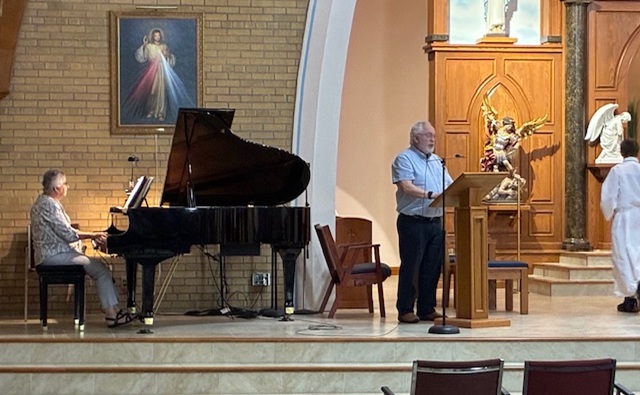
In recent years, I’ve sung at dozens of funerals in various Catholic churches. Sometimes in a funeral choir, but most often as a cantor (soloist). The family often picks the songs to be sung and in what order they are to be sung. This sometimes makes it awkward for the cantor and accompanist. A family might choose “How Great Thou Art” as an opener when the casket or cremains are brought in, but there are many other songs that are gentler and more suited to the processional when the casket or cremains are brought in. A family might choose “Amazing Grace” as the closing song, but it’s more of a worship song than a closer. Here, “How Great Thou Art” makes a stronger closing song. In general, families tend to pick songs or hymns they are familiar with.
Once in a while, the family will let the musicians pick the songs and the order of singing them, which makes sense. If the deceased or the family had a favorite hymn, it is easy to insert that hymn in a meaningful place. “Precious Lord” is such a song that can be used as an opening hymn, or inserted during the ceremony at a meaningful time, or even used as the closing song.
Now and then, a family will choose a gospel song or two with a little more swing that can bring a physical reaction from the mourners, either handclapping or just moving in place. Some years back, when a wonderful lady died, she had been married to a colored husband. Her two colored daughters asked if we could sing their mother’s favorite hymn, “We’ve Come This Far By Faith.” It is a terrific faith song. We got a copy of the song and sang it. You can hear it played by my son, Dan Murphy, who is a professional jazz pianist in Chicago and the Music Director at St. James on Wabash; just go click below on the video We’ve Come This Far By Faith, Dan Murphy. It’s a real toe tapper with great faith lyrics.
Another point that causes me to wonder at Catholic funerals is at communion time. The bishop has ordered the priests to say: “At communion time, when the body, blood, soul, and divinity of Jesus Christ is to be distributed, we invite all Catholics in good standing with the Church to come forward to receive. There are two ways to receive the consecrated host. When the priest or communion helper holds up the host and says “The Body of Christ,” as you answer “Amen,” either make a throne with one hand and place the other hand open upon it, and when the host is put into your hand use the bottom hand to pick up the consecrated host, and immediately place it on your tongue before you walk back to your pew; or simply open your mouth to receive Christ on your tongue. Everyone else is invited to come forward for a blessing; just cross your hands across your chest and I will give you a blessing.” A few people tend to come forward to receive that blessing.
The Catholic church teaches officially that while all seven sacraments forgive minor (venial) sins, only Baptism, Reconciliation (Confession), and the Anointing of the Sick forgive major sins. A major sin is when a person has broken away from the church, perhaps to live with someone without getting married, or sinned in some other serious way and has not yet asked a priest for forgiveness in the Sacrament of Reconciliation. It’s a theological development Jesus of Nazareth did not make. When people came forward to ask Jesus to cure their ill health, their leprosy, their muteness, their blindness, their lack of faith, or even the death of a loved one, Jesus thanked them for their request and faith in him and healed the person.
Jesus welcomed everyone. I believe the Catholic church today should welcome everyone who believes in the forgiving and healing grace/love Jesus brings in Holy Communion to those who open their hearts to receive his life-giving Spirit, even if they are not Catholic. When the Holy Spirit came upon the Apostles at Pentecost, it filled their hearts with hope, courage, and faith to share that forgiveness and spiritual strength with everyone they met. Receiving Jesus in Communion is like a Pentecost for those who truly want peace in their lives. Like the woman at the well in JOHN 6 or the woman caught in adultery in JOHN 8, Jesus gave forgiveness and/or healing because, at that moment, they believed in Him. Funerals are as much for the living mourners as for the deceased.
I am proud of the fact that most priest or deacon funeral celebrants wear white vestments for the funeral liturgy. It’s a sign of the resurrection of Christ, a sign of faith and hope. It’s an update that dates to the Second Vatican Council in 1964. I am also fortunate and thankful that my wife Mary, is a musician who can accompany me on the organ or piano when I am asked to sing at funerals.
Hi, are you the same Michael Murphy who was a priest at St John’s in Little Chute?
Dar, I was slow to reply to your note just before Christmas. Thank you for bringing me up to date on what you’ve been up to.
It’s nice to know you are still singing and playing guitar. You understand how much time it takes to practice and prepare for
a chance to sing somewhere. I used to sing and play at Retirement Homes, etc., but as I began to research and write, my time with
the guitar became less and less. I miss it. One of these days, a Christmas carol I wrote I will put on my website. I used it in
place of the fifty or so Christmas cards I used to send, but it took longer than I had planned to set it up properly and record
it. Hopefully by the end of the week it will appear on my Website. I believe I tried to send it to you. If you didn’t get it, emmail me your phone number and I will try another way. Hope things are going well for you, Dar. We will have to meet sometime
in this New Year, perhaps on a Saturday. Keep smiling, Mike